


Litigating Against a Narcissist

For individuals contemplating or currently navigating a divorce from a partner exhibiting narcissistic traits, there is often a dawning, unsettling realization: this is not a normal separation. Conventional advice about amicable settlements, collaborative law, and finding a middle ground does not apply. The feelings of confusion, exhaustion, and of being constantly on the defensive are not figments of an overactive imagination; they are the predictable and intended outcomes of engaging with a personality structured around control, entitlement, and a profound lack of empathy. This is not a legal dispute between two rational adults seeking an equitable end to a partnership. It is a form of psychological warfare waged within the confines of the legal system.
Success in this environment requires a fundamental and immediate shift in mindset. The goal is not to convince the narcissistic spouse of a particular point of view, to make them see reason, or to achieve an emotional resolution. Such objectives are not only unattainable but pursuing them will deplete the very resources—financial, emotional, and psychological—needed to secure a safe and stable future. The singular, overriding objective is to disengage legally and emotionally by building an unassailable, evidence-based case that compels a judge to issue clear, specific, and rigorously enforceable orders.3
This process is a marathon, not a sprint. It demands discipline, emotional fortitude, and a strategic approach that anticipates the opponent’s moves. The narcissist’s need to “win” often outweighs any rational consideration, including the well-being of the children or the preservation of assets. They will likely attempt to control every facet of the divorce, from financial disclosures to parenting schedules, not to achieve a fair outcome, but to maintain a position of power and inflict punishment.
By understanding the terrain and the opponent, it is possible to move from a reactive, defensive posture to a proactive, strategic one, navigating the complexities of the legal system to achieve the ultimate victory: freedom.
Deconstructing Narcissistic Tactics
To effectively litigate against a narcissistic spouse, one must first possess a deep and functional understanding of their predictable patterns of behavior. This is about recognizing a consistent set of tactics that are deployed to manipulate, control, and destabilize. By learning to identify these moves, one can anticipate them, neutralize their impact, and avoid the common emotional traps that derail a legal strategy. The narcissist’s actions, while seemingly chaotic and cruel, are not random. They stem from a rigid personality structure, and this predictability is a significant strategic vulnerability that can be exploited.
Core Narcissistic Traits in Litigation
Several core personality traits consistently manifest in the behavior of a narcissist during legal disputes, shaping their every action and decision.
Lack of Empathy & Sense of Entitlement
A defining characteristic is a profound inability to recognize or identify with the feelings and needs of others. In a divorce context, this means the narcissist genuinely cannot comprehend their spouse’s perspective, the emotional impact of their actions on their children, or the concept of a fair and equitable division of a shared life. This is coupled with an overwhelming sense of entitlement—a belief that they deserve to have whatever they want, whether it be the majority of the assets, primary custody of the children, or freedom from financial obligations. They view the legal process not as a mechanism for fair resolution, but as a venue to validate their perceived superiority and claim what they believe is rightfully theirs, irrespective of the law or the facts.
Need for Control & The “Win-at-all-Costs” Mentality
The divorce represents a significant narcissistic injury—a loss of control over their partner and their carefully constructed image. In response, they will attempt to control every aspect of the legal proceedings, from dictating communication terms to refusing to compromise on even the most trivial issues. This need for control is not driven by a desire for a particular outcome that is logical or beneficial, but by the need to dominate the process itself. For the narcissist, the divorce is a zero-sum game. There is no mutual agreement, only winning and losing. This mentality means their primary motivation is often not the children’s best interests or a swift resolution, but their own gratification, the assertion of power, and the punishment of their former spouse for daring to leave.
Projection of Blame & Inability to Accept Responsibility
Narcissists possess a fragile ego that cannot tolerate criticism or the admission of fault. Consequently, they will externalize all blame for the breakdown of the marriage and any subsequent conflict during the divorce. They will construct a narrative in which they are the perpetual victim and their spouse is the sole cause of all problems. This projection is a key defense mechanism and a cornerstone of their legal strategy. They will accuse their partner of the very behaviors they themselves are engaging in, a tactic that can be incredibly disorienting and emotionally damaging if not properly understood.
Common Manipulative Tactics Decoded
These core traits give rise to a specific and repeatable set of manipulative tactics used to destabilize the opposing party and manipulate the legal system.
Gaslighting
Gaslighting is a pernicious form of psychological manipulation intended to make the target question their own memory, perception, and sanity. In a divorce, this manifests in phrases like, “That never happened,” “You’re imagining things,” “I never said that,” or “You’re being paranoid”. The narcissist will deny events that clearly occurred or twist facts to fit their narrative, leaving their spouse feeling confused and doubting their own grasp on reality. The most effective countermeasure to gaslighting is meticulous, contemporaneous documentation. A detailed journal or log of events serves as an external, objective record of reality, providing an anchor of truth that can prevent self-doubt and form the basis of a factual timeline for the court.
DARVO (Deny, Attack, and Reverse Victim and Offender)
This is a common and powerful reaction to being held accountable for their behavior. The acronym stands for Deny, Attack, and Reverse Victim and Offender.7 When confronted with wrongdoing, the narcissist will first
Deny the behavior. Then, they will Attack the person confronting them for raising the issue. Finally, they will Reverse the roles, claiming that they are the actual victim in the situation and the accuser is the true offender. For example, if confronted about financial abuse, a narcissist might deny hiding assets, attack their spouse for being greedy and untrusting, and then claim they are the one being financially victimized. Understanding this predictable sequence is crucial, as it prepares the client for the inevitable counter-accusations that will follow any attempt to introduce evidence of their misconduct.
Smear Campaigns & False Accusations
To control the narrative and isolate their spouse, a narcissist will often launch a smear campaign, systematically spreading lies, rumors, and half-truths to mutual friends, family, colleagues, and even the children. Their goal is to damage their spouse’s reputation and support system, painting themselves as the sympathetic victim. In court, this escalates to making outright false accusations. A narcissist will not hesitate to lie under oath or fabricate stories of abuse, addiction, or instability to gain an advantage, particularly in custody disputes. The appropriate response is not to engage in a public relations battle but to maintain composure and address these falsehoods calmly and factually through legal channels, supported by evidence and witness testimony.
Using Children as Pawns
For a narcissist, children are often not viewed as individuals with their own needs but as instruments to be used for leverage and control. They may use the children as bargaining chips in negotiations, attempting to trade custody time for financial concessions. They may use them as messengers to relay manipulative or harassing communications, placing the children directly in the middle of adult conflict. Most destructively, they may attempt to alienate the children from the other parent, poisoning their relationship with disparaging remarks and creating loyalty conflicts in an effort to “win” the children’s allegiance. This behavior is profoundly damaging to a child’s psychological well-being and must be addressed with firm legal boundaries and, often, therapeutic intervention for the children.
The collection of these behaviors is not a sign of a brilliant, unpredictable strategist. It is a rigid, compulsive playbook driven by a fragile ego’s desperate need for control and validation, often referred to as “narcissistic supply.” The divorce process, by its very nature, threatens this supply and control, triggering a predictable escalation of these tactics. This predictability is the key. Recognizing that these behaviors are almost certain to occur allows for the preparation of countermeasures in advance. Instead of being shocked and destabilized by a false accusation or a gaslighting attempt, the client and their legal team can have the documentation, witnesses, and legal motions ready to deploy. This strategic foresight shifts the dynamic from a constant state of defense to a position of prepared, proactive engagement.
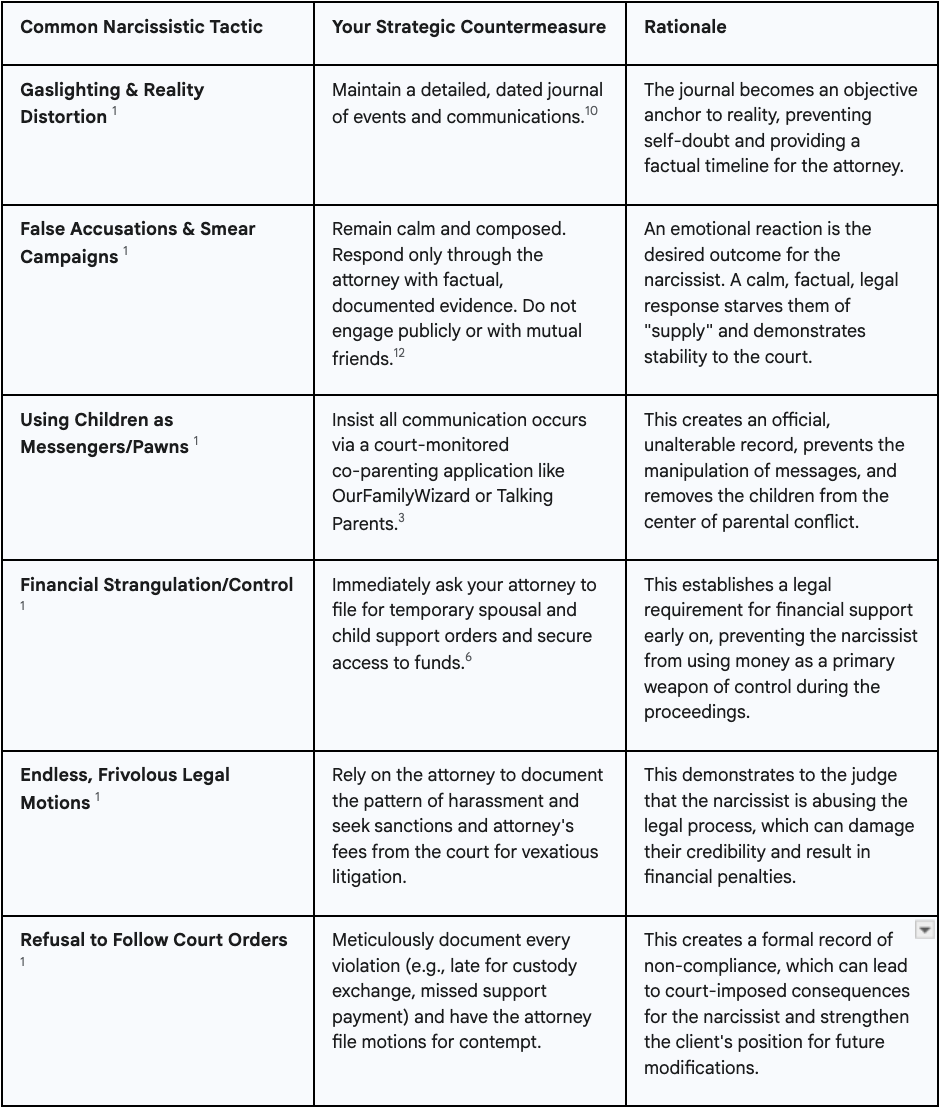
The following table provides a quick-reference framework for understanding these common tactics and their corresponding strategic countermeasures. This tool is designed to move the client from an emotional reaction to a calculated, strategic response.
The Three Pillars of a Rock-Solid Legal Strategy
In a high-conflict divorce, feelings, accusations, and personal narratives hold little weight without corroboration. The court system operates on evidence, procedure, and established legal standards. Therefore, transitioning from a victim of narcissistic abuse to a successful litigant requires a disciplined focus on building an irrefutable case. This is achieved through three foundational pillars: assembling the right legal team, committing to exhaustive documentation, and framing the case through the objective lens of the court.
Pillar I: The Right Legal Team – Your Strategic Partner
The single most important decision a person will make at the outset of this process is the selection of their legal counsel. This is not the time for a family friend who dabbles in law or a general practitioner. The unique challenges posed by a narcissistic opponent demand specialized expertise.
Not all family law attorneys are equipped to handle the complexities of a high-conflict case involving a personality-disordered individual. It is imperative to retain a lawyer with specific, verifiable experience in litigating against narcissists. These attorneys understand the playbook. They will not be surprised by stonewalling, false accusations, or a refusal to negotiate. They are prepared for a protracted battle and have strategies in place to manage the narcissist’s tactics, such as their propensity to file frivolous motions designed to harass and deplete financial resources.
What to Ask in a Consultation
During initial consultations, the client should be prepared to interview potential attorneys as rigorously as they would any other critical professional. Key questions can reveal whether a lawyer has the necessary experience and temperament:
- “What is your specific experience litigating divorces against individuals with narcissistic personality traits?”
- “How do you approach a case where the opposing party refuses to provide financial discovery or negotiate in good faith?”
- “What is your strategy for managing a client’s legal fees when an opponent is intentionally drawing out the process?”
- “How do you protect clients from the emotional toll and harassment that often accompany these cases?”
The answers to these questions will provide insight into the attorney’s strategic thinking and their familiarity with the unique challenges ahead.
The Lawyer’s Role as a Buffer
A crucial function of an experienced high-conflict attorney is to act as an intermediary and a protective buffer. All communication should be routed through the legal teams. This immediately creates a barrier against direct emotional abuse, manipulation, and harassment. The attorney can filter out the noise, respond strategically to threats and demands, and ensure that all interactions are formal and documented. This professional barrier is not just a convenience; it is a vital component of the strategy to disengage emotionally and protect the client’s mental well-being, allowing them to focus on the substantive aspects of their case.
Document and Record Everything
If the right lawyer is the general, then documentation is the army. In a “he said, she said” battle against a person who has no qualms about lying, even under oath, the party with the most thorough, organized, and credible evidence will prevail. Documentation is the only effective antidote to gaslighting and fabrication. It transforms subjective experience into objective fact, creating a clear and compelling narrative for the court. This is the single most critical task for the client throughout the entire legal process.
The very act of documenting provides a powerful psychological benefit. Narcissistic abuse, particularly gaslighting, is designed to erode a person’s confidence in their own perceptions and memory. The disciplined process of writing down the specific, factual details of an interaction—the date, the time, the exact words used—forces an engagement with objective reality. It creates a personal, undeniable record of the abuse. When feelings of self-doubt arise, this record serves as a concrete anchor to the truth, systematically rebuilding self-trust and affirming one’s own sanity. This restored confidence is invaluable, as a client who is grounded in the facts presents as a far more credible and composed witness in depositions and court proceedings, less susceptible to the narcissist’s attempts to trigger or manipulate them.
What to Document
The scope of documentation should be exhaustive.
- Communications: Every single email, text message, and social media post should be saved and backed up. Voicemails should be transcribed.16 It is essential to communicate in writing whenever possible to create a word-for-word record of every conversation.3 Using a court-admissible co-parenting application like OurFamilyWizard or Custody X Change is highly recommended, as these platforms create an unalterable, timestamped log of all communication.
- Events & Interactions: A detailed, factual journal or diary should be maintained. This log should record dates, times, locations, and a dispassionate account of what was said and done by each party. Any witnesses to an event should be noted. It is critical to stick to objective facts (“He arrived 45 minutes late for the custody exchange”) rather than emotional interpretations (“He was late just to upset me”).
- Financials: Every available financial document should be gathered and copied: bank statements, tax returns, pay stubs, credit card bills, loan applications, and investment reports. This evidence is vital for uncovering hidden assets and proving financial abuse.
- Parenting Issues: A specific log should be kept detailing all parenting-related incidents. This includes every missed or late visitation, every time the children are returned in a distressed state, every disparaging remark the narcissist makes about the other parent to the children, and every failure to adhere to the parenting schedule or co-parenting agreements.
How to Organize Evidence
Collected evidence is only useful if it can be presented clearly and effectively. It is advisable to create a chronological timeline of key events. This visual representation can be a powerful tool in court, illustrating a consistent pattern of abusive or obstructive behavior over time. Evidence should also be categorized logically—for example, into folders labeled “Financial Abuse,” “Communication Records,” “Parenting Violations,” and “Witness Statements.” This organization allows the legal team to quickly access specific pieces of evidence needed to refute a false claim or support a motion.
Framing Your Case
The court is not a therapy session. A judge’s role is to apply the law to a set of proven facts. Therefore, the entire case must be framed in a way that aligns with legal standards and presents the client as the reasonable, stable, and credible party.
Focus on Behavior, Not Labels
It is a common and understandable impulse to want to tell the judge, “My spouse is a narcissist.” However, this is often a strategic error. Judges are interested in specific, documented behaviors and their impact, not clinical diagnoses made by a layperson. The legal team’s job is to take the client’s experience and translate it into a compelling legal argument supported by evidence. Instead of saying, “He’s a narcissist,” the case should demonstrate, “Here is a documented pattern of 57 instances of financial deception,” or “Here are 32 emails containing harassing and threatening language.” The evidence of the behavior is what proves the case, not the label.
The “Best Interests of the Child” Standard
In any custody dispute, the court’s primary and often sole consideration is the “best interests of the child”. This is the legal standard that must guide every argument related to the children. The focus should not be on what a parent wants or feels they deserve. Instead, every piece of evidence and every request made to the court must be framed in terms of how it serves the child’s need for safety, stability, and well-being. The case must clearly demonstrate how the narcissistic parent’s behavior (e.g., their emotional volatility, their attempts at alienation, their neglect of the child’s needs) is detrimental to the child, and conversely, how the client’s proposed parenting plan provides a stable, nurturing, and protective environment.
Gathering Witnesses
Third-party testimony can be crucial for corroborating claims and breaking through the “he said, she said” dynamic. While testimony from close friends and family can be helpful, judges may view it with some skepticism due to potential bias. Therefore, testimony from neutral, third-party witnesses is especially valuable. This can include teachers, school counselors, pediatricians, therapists, or neighbors who have observed the narcissist’s behavior or its negative impact on the children. These unbiased accounts can provide the court with a more objective and credible picture of the family dynamic.
Protecting Your Assets and Future
In a high-conflict divorce, finances are rarely just about money. For the narcissist, money is a primary tool for exerting power, control, and punishment. Financial abuse is a near-universal feature of these cases, used to intimidate a spouse into submission, prolong the legal battle, and cripple their ability to establish an independent life. Recognizing these tactics and implementing a robust defensive and offensive financial strategy from the very beginning is not just advisable; it is essential for survival.
The financial games played by a narcissist are a direct extension of their psychological makeup. The need for control and the sense of entitlement manifest as a belief that all marital assets belong to them, regardless of how they were acquired. Money is used to punish the departing spouse for their perceived betrayal and to maintain a state of dependency, thereby prolonging the narcissist’s control even after the relationship has ended. Therefore, any attempt to appeal to fairness, shared history, or the needs of the family is destined to fail. The only effective approach is to depersonalize the process entirely, removing all emotion and treating the financial separation with the cold, methodical rigor of a business dissolution or a forensic audit. This business-like approach is not only emotionally protective for the client but is also the language of data and evidence that the court understands and respects.
Recognizing Narcissistic Financial Abuse
Financial abuse is defined as the use of financial resources to manipulate, intimidate, and control a partner. It is present in an estimated 99% of domestic violence cases and is a powerful method for trapping a victim in an abusive relationship. During a divorce, this abuse often escalates and takes on specific forms.
Common Tactics During Divorce
- Hiding Assets & Refusing Disclosure: Believing they are above the law, narcissists will frequently and actively hide assets to prevent an equitable division. This can involve transferring funds to secret bank accounts, concealing investments, underreporting income from a cash business, or temporarily “gifting” assets to friends or family. They will often refuse to comply with standard financial disclosure requirements (discovery), ignoring requests for documents and stonewalling the process.
- Manufacturing Debt & Ruining Credit: A common punitive tactic is to intentionally damage the other spouse’s financial standing. This can include running up large debts on joint credit cards right before or during the separation, refusing to pay bills for which the other spouse is also responsible (like a mortgage or car loan), and taking other actions designed to destroy their credit score. A poor credit rating can severely limit a person’s ability to secure housing, obtain loans, and regain financial independence.
- Stonewalling & Drawing Out Proceedings: The narcissist understands that litigation is expensive. One of their most effective financial weapons is to prolong the divorce process unnecessarily.6 By refusing to negotiate, filing frivolous motions, and forcing every minor issue to be litigated, they aim to drain their spouse’s financial resources, hoping to force them into accepting an unfair settlement out of sheer exhaustion and financial desperation.
- Employment Sabotage: To maintain control and dependency, a narcissist may actively sabotage their spouse’s career. This can range from forbidding them from seeking promotions or better employment to more overt actions like harassing them at their workplace, calling their boss with false accusations, or creating manufactured emergencies that cause them to miss work or important meetings.
Your Financial Protection Plan
Countering these tactics requires a proactive, multi-pronged strategy executed in close coordination with the legal team.
Assemble Your Team
While a skilled high-conflict attorney is the cornerstone of the team, complex financial situations often require additional expertise. A forensic accountant can be an invaluable asset. These professionals are trained to trace hidden assets, analyze financial records for inconsistencies, value businesses, and provide expert testimony in court about financial deception. Their work can uncover the truth behind the narcissist’s manipulated financial picture.
Secure Your “War Chest”
Litigation against a narcissist is a costly endeavor, and they will use this fact to their advantage. If at all possible, before filing for divorce, it is critical to secure access to liquid funds in a separate bank account held solely in the client’s name. This “war chest” will be used for legal fees and essential living expenses during the initial stages of the divorce, providing the necessary resources to withstand the narcissist’s attempts at financial strangulation.
Establish Your Own Credit
Many victims of financial abuse have been systematically excluded from the family’s financial life and may have little or no credit in their own name. It is vital to begin building an independent credit history as soon as possible by opening credit cards and bank accounts solely in one’s own name. A solid credit history is fundamental to securing future financial stability.
Utilize Legal Tools Immediately
The legal system provides powerful tools to protect against financial abuse, and they must be deployed swiftly.
- Temporary Support Orders: Immediately upon filing, the attorney should request temporary orders for spousal support (alimony) and child support from the court. These orders establish a legal obligation for the narcissist to provide financial support while the divorce is pending, ensuring a flow of income for the client and children and preventing the narcissist from simply cutting off all funds.
- The Discovery Process: This is the formal legal process for exchanging information. The legal team will use tools like interrogatories (written questions), requests for production of documents, and subpoenas to compel the narcissist to disclose all financial information. While the narcissist may resist, their refusal to comply can be documented and used to request sanctions from the court, which can damage their credibility and result in penalties.
- Financial Restraining Orders: In many jurisdictions, automatic temporary restraining orders (TROs) go into effect upon the filing of a divorce, preventing either party from making unusual expenditures, selling assets, or changing insurance beneficiaries. Where these are not automatic, the attorney can petition the court for specific financial restraining orders to prevent the narcissist from dissipating the marital estate.
Section 4: Mastering Communication: Seizing Control of the Narrative
Communication with a narcissistic spouse during a divorce is not a dialogue; it is a minefield. Every interaction is an opportunity for them to manipulate, provoke, gaslight, and gather information to use as ammunition. The goal of a strategic communication plan is to fundamentally shift this dynamic. It involves shutting down the avenues for abuse, refusing to provide the emotional reaction (narcissistic supply) they crave, and creating a clear, unimpeachable record for the court. This disciplined approach is not a passive defense; it is an active strategy to impose accountability where none has existed before.
By consistently adhering to documented, emotionless communication methods, the client fundamentally alters the power dynamic. Narcissists thrive in the ambiguity of “he said, she said” conflicts, where they can lie and distort reality without consequence. Moving all communication to a recordable, unalterable format, such as a court-approved co-parenting app, eliminates this ambiguity. Every word is documented, timestamped, and admissible as evidence. The narcissist becomes acutely aware that any threat, lie, or manipulation will be permanently recorded, creating a powerful disincentive for such behavior. While their personality remains unchanged, their behavior is often forced to adapt to this new reality of accountability. This disciplined communication builds a virtual cage of accountability around the narcissist’s interactions.
The New Rules of Engagement
To regain control, one must stop playing by the narcissist’s rules and establish a new, non-negotiable protocol for all communication.
Set Firm Boundaries
Boundaries must be established early, clearly, and in writing. The client, through their attorney, should state precisely how and when they will communicate. For example, a boundary might be: “I will only communicate about logistical matters related to the children. I will not discuss our past relationship, my personal life, or any other topic. All communication must be conducted through the co-parenting app.” Once a boundary is set, it must be enforced with absolute consistency. Any attempt by the narcissist to violate it should be met with a calm restatement of the boundary or, more often, with silence.
Written Communication Only
All verbal communication should cease. Phone calls and in-person conversations are the narcissist’s preferred arenas, as they are not easily recorded and provide fertile ground for emotional escalation, intimidation, and manipulation. The rule must be an insistence on using email, text messages, or, most preferably, a dedicated co-parenting application. This creates a clear, searchable, and admissible record of every single exchange.
Minimize and Disengage
Communication should be limited to that which is absolutely necessary for co-parenting or resolving legal logistics. The client must resist the urge to JADE: Justify, Argue, Defend, or Explain. The narcissist is not seeking understanding; they are seeking engagement and an emotional reaction. Arguing with them is futile and only serves to provide them with the attention they crave. Responding to accusations or provocations only validates their tactic and draws the client deeper into a toxic dynamic.
Communication Techniques for High-Conflict Situations
When a response is unavoidable, specific techniques can be used to neutralize the narcissist’s attempts at manipulation and maintain control of the interaction.
The BIFF Method
Developed by the High Conflict Institute, the BIFF method provides a simple, memorable framework for all written responses. A BIFF response should be:
- Brief: A few sentences at most. Long explanations provide material for the narcissist to attack.
- Informative: Stick to straight, objective facts. Answer the question or provide the necessary logistical information without adding emotion or opinion.
- Friendly: This does not mean warm or chatty. It means civil and respectful in tone, avoiding sarcasm, insults, or accusations. A neutral, business-like tone is ideal.
- Firm: The response should clearly state the decision or end the conversation. It should not invite further debate or negotiation.13
For example, if the narcissist sends a long, accusatory email about a scheduling change, a BIFF response would be: “Thank you for the email. To confirm, I will pick up Jane at 5:00 PM on Friday as per the court order. Best,.” This response is brief, informative, friendly (civil), and firm, giving the narcissist no emotional hooks to latch onto.
“Grey Rocking”
The “Grey Rock” method involves making oneself as boring and unresponsive as a grey rock. The goal is to become an uninteresting target. Responses should be short, factual, and devoid of emotion. When the narcissist realizes they can no longer elicit a dramatic reaction, they often lose interest and seek their narcissistic supply elsewhere. This technique requires significant emotional discipline but is highly effective at starving the narcissist of the attention and conflict they feed on.
Strategic Non-Response
Not every message requires a response. Harassing, baiting, insulting, or off-topic communications should be documented but often are best met with silence. A non-response is a powerful message that the client will not engage in unproductive and abusive exchanges. It demonstrates control and a refusal to be drawn into the narcissist’s drama.
Using Technology as a Shield
Modern technology offers powerful tools for managing high-conflict communication and creating an evidentiary record.
Co-Parenting Applications
Platforms like OurFamilyWizard, Talking Parents, and others are specifically designed for high-conflict co-parenting situations.4 Their use should be required in the court-ordered parenting plan. Key features often include:
- Unalterable Messaging: All communications are timestamped and cannot be deleted or edited, creating a reliable record for the court.
- Tone Meters: Some apps have features that flag hostile or inflammatory language before a message is sent, giving the sender an opportunity to reconsider their wording.
- Shared Calendars: These can be used for scheduling parenting time, appointments, and activities, reducing ambiguity and potential for conflict.
- Expense Logs: These tools allow parents to track and request reimbursement for shared child-related expenses, creating a clear financial record and minimizing disputes over money.
By funneling all communication through such a platform, the client creates a neutral, documented, and accountable space that inherently discourages the narcissist’s most common manipulative tactics.
Custody and Co-Parenting in a High-Conflict Environment
For most parents, the well-being of their children is the highest priority in a divorce. When one parent is a narcissist, this protective instinct must be channeled into a highly structured and legally fortified strategy. The emotional and psychological safety of the children is paramount, as they are uniquely vulnerable to the manipulation, conflict, and emotional neglect characteristic of a narcissistic parent. The goal is to create a legal framework that minimizes the children’s exposure to conflict and provides them with at least one stable, emotionally attuned parent to serve as their safe harbor.
The Narcissist as a Parent
Understanding the typical parenting patterns of a narcissist is the first step in crafting a protective legal strategy.
Children as Extensions of Self
Narcissists often struggle to see their children as separate, autonomous individuals with their own thoughts, feelings, and needs. Instead, children are frequently viewed as extensions of the narcissist’s own ego—objects that exist to serve their needs. A child may be valued for their achievements (as it reflects well on the parent) or devalued if they fail to meet the narcissist’s expectations or needs for admiration (“narcissistic supply”). This can lead to a parenting style that is not focused on the child’s development but on the parent’s self-gratification.
Inconsistent and Manipulative Parenting
Parenting from a narcissist can be erratic and conditional. They may be neglectful when a child’s needs are inconvenient or a “nuisance,” but become intensely involved when the child can be used to serve their agenda, such as projecting an image of a perfect parent to the outside world. They will frequently undermine the other parent’s authority, creating confusion and loyalty binds for the children. They may make promises they have no intention of keeping, causing disappointment and emotional harm, and will often blame the other parent for their own failings.
Legal Strategies for Child Protection
Given these dynamics, informal, flexible parenting arrangements are destined to fail. Protection for the children must be codified in detailed, unambiguous court orders.
The Detailed Parenting Plan
This document is the single most important legal tool for protecting children in a high-conflict divorce. The parenting plan must be meticulously detailed, anticipating potential areas of conflict and leaving no room for interpretation or manipulation. A robust plan should specify:
- Schedules: Exact pickup and drop-off times, locations, and designated responsible parties for all exchanges. Holiday and vacation schedules should be outlined for several years in advance.
- Communication: Clear rules for how and when parents can communicate with the children during the other parent’s time. A “right of first refusal” clause should be included, specifying the conditions under which a parent must offer parenting time to the other parent before using a third-party caregiver.
- Decision-Making: The plan must clearly delineate who has decision-making authority (sole or joint) for major areas such as education, non-emergency medical care, and religious upbringing. If decision-making is joint, a dispute resolution mechanism (like mediation) must be included.
- Behavioral Clauses: The plan should include specific clauses prohibiting either parent from disparaging the other in front of the children, using the children as messengers, or discussing the legal case with them.
Requesting a Custody Evaluation
In cases where a parent’s personality and behavior are a central concern, requesting a custody evaluation (or social study) can be a powerful strategy. This is an in-depth investigation conducted by a neutral mental health professional or social worker appointed by the court. The evaluator will interview both parents, the children, and collateral contacts (like teachers and therapists), conduct psychological testing, and observe parent-child interactions. The resulting report provides the court with a professional, third-party assessment of the family dynamics and a recommendation for a custody arrangement that serves the children’s best interests. This can be one of the most effective ways to expose a narcissist’s true personality and parenting deficits to a judge.
Your Role as the Stable Parent
While the legal strategy creates the necessary structure, the client’s day-to-day actions as a parent are what will ultimately provide the children with the stability and security they need.
Be the Safe Harbor
The primary role of the non-narcissistic parent is to be the consistent, emotionally stable, and attuned parent. This means creating a home environment where the children feel physically and emotionally safe, where their feelings are validated, and where they can speak openly without fear of judgment or manipulation. This stable base provides a crucial counterbalance to the potential chaos and emotional unpredictability of the other home.
Do Not Badmouth the Other Parent
As tempting and justified as it may feel, it is critical to refrain from disparaging the narcissistic parent in front of the children. Children naturally love both of their parents, and hearing one denigrate the other places them in an emotionally damaging loyalty conflict. Instead of criticizing the person, the focus should be on teaching the children healthy coping skills. This can involve validating their feelings (“I understand it feels confusing when plans change suddenly”) and helping them develop tools to navigate difficult interactions.
Get Therapy for Yourself and the Children
Professional support is not a luxury in these situations; it is a necessity. A therapist experienced in narcissistic abuse can provide the client with essential coping strategies and emotional support. Therapy for the children with a qualified professional can provide them with a neutral space to process their confusing and often painful experiences. It can equip them with the language to describe their feelings and the skills to maintain healthy emotional boundaries, which will serve them for the rest of their lives.
Sustaining Your Emotional and Mental Fortitude
A legal battle against a narcissist is not merely a legal process; it is a grueling test of endurance. The narcissist’s strategy is often one of attrition—to wear down their opponent emotionally, psychologically, and financially until they capitulate. Therefore, a brilliant legal strategy is only as effective as the client’s ability to sustain the will to execute it. Self-preservation is not selfish; it is a core component of the overall strategy. Maintaining emotional and mental fortitude is essential for making clear decisions, being a credible witness, and having the resilience to see the process through to its conclusion.
Acknowledge the Toll
The first step in managing the immense stress of this process is to acknowledge its reality. It is normal and expected to feel overwhelmed, exhausted, anxious, and angry. The narcissist’s tactics—the constant conflict, the gaslighting, the false accusations—are designed to keep their target in a state of heightened emotional distress.1 Validating these feelings and understanding that they are a predictable result of the abuse is crucial for preventing self-blame and burnout. This is a marathon, and pacing, rest, and support are required to reach the finish line.
Build Your Support System
No one can endure this process alone. A multi-layered support system is vital for survival and success.
Therapy is Non-Negotiable
Engaging a therapist who has specific experience with narcissistic abuse and high-conflict divorce is arguably as important as hiring the right attorney. A therapist provides a confidential space to process the trauma of the relationship and the stress of the litigation. They can offer invaluable tools for managing emotional triggers, setting boundaries, and developing effective coping mechanisms. A therapist also serves as a “reality check,” helping to counteract the effects of gaslighting and affirm the client’s perceptions.
Trusted Circle
It is important to identify a small, trusted circle of friends or family who can provide consistent emotional support. This should be a group of people who are unequivocally on the client’s side and who will not be susceptible to the narcissist’s manipulation. It is wise to exercise caution with mutual acquaintances, as the narcissist will likely attempt to use them in their smear campaign. The support network’s role is not to offer legal advice but to listen, validate, and provide a respite from the conflict.
Support Groups
Connecting with others who have gone through similar experiences can be incredibly powerful. Online or in-person support groups for survivors of narcissistic abuse can provide a sense of community and validation that is difficult to find elsewhere. Hearing from others who understand the unique dynamics of this type of abuse can dramatically reduce feelings of isolation and provide practical, lived-experience advice.
Practice Self-Care
In the context of high-conflict litigation, self-care is not an indulgence; it is a strategic imperative.
Maintain Composure
The narcissist’s primary goal is often to provoke an emotional reaction. An outburst of anger or a flood of tears can be used against the client in court, portrayed as evidence of instability. Learning to remain calm and composed, especially during direct interactions like depositions or court appearances, is a superpower. This is not about suppressing feelings, but about choosing when and where to express them—in a therapist’s office or with a trusted friend, not in front of the opponent or the judge. Techniques like deep breathing, mindfulness, and preparing scripted, neutral responses can be invaluable.
Prioritize Physical and Mental Health
The extreme stress of this process takes a significant physical and mental toll. Prioritizing basic health needs is fundamental to maintaining resilience. This includes a commitment to regular exercise, a healthy diet, and adequate sleep. Activities that reduce stress, such as meditation, yoga, or spending time in nature, should be scheduled into the week with the same priority as a legal appointment.
Disconnect and Live Your Life
It is easy for the divorce to become an all-consuming entity that dominates every thought and conversation. It is vital to consciously create space away from the conflict. This means setting aside specific times when the case will not be discussed or worked on. It means engaging in hobbies, spending quality time with children that is unrelated to the divorce, and taking steps to build a new, independent life. The more the client invests in their own future and well-being, the less power the narcissist’s machinations will have over them.
Conclusion
In the long and arduous process of divorcing a narcissist, it is easy to lose sight of the objective. The conventional notion of “winning”—of achieving a dramatic courtroom confession or a moment of vindication where the narcissist finally admits fault—is a dangerous illusion. To pursue such a goal is to remain emotionally entangled and to play a game that cannot be won on those terms. Victory in this context must be redefined. It is not about emotional satisfaction; it is about strategic success and the attainment of a lasting peace.
Victory is an enforceable order. The final divorce decree, the detailed parenting plan, and the qualified domestic relations order are the tangible trophies of this battle. These are not just pieces of paper; they are legally binding documents that create the boundaries, rules, and structures that were absent in the relationship. A clear order that specifies exact parenting times prevents future arguments. A court-mandated financial settlement that cannot be unilaterally changed by the narcissist provides security. These orders are the legal shield that will protect the client and their children long after the lawyers have gone home.
Ultimately, victory is freedom. It is the successful extrication of oneself and one’s children from a toxic, abusive, and psychologically damaging dynamic. It is the freedom to build a home environment free from constant conflict, manipulation, and emotional turmoil. It is the freedom to make personal and financial decisions without needing to justify, argue, or defend them. It is the freedom for children to grow up with at least one parent who can provide a consistent and emotionally safe environment.
The journey is undeniably difficult, and the financial and emotional costs can be immense. However, this legal battle should be viewed not as an end in itself, but as a necessary and temporary investment in a future of peace, autonomy, and security. The true victory is not in defeating the opponent, but in successfully disengaging from them and reclaiming control over one’s own life and happiness. The future is not defined by the conflict of the past, but by the peace that is fought for and won in the present.
If you are facing the challenges of divorcing a narcissistic spouse, you don’t have to navigate the battle alone. The experienced attorneys at Bundy Law understand the unique dynamics of high-conflict divorce and will fight to protect your rights, your children, and your future. Contact Bundy Law today to schedule a confidential consultation.

© 2026 Bundy Law. All Rights Reserved.
Digital Marketing By: 